

I’m always curious about why people risk their lives for an important goal when the odds are stacked against them. What is the source of their courage?
In Iran, we saw an explosion of courage in January. Huge, nationwide protests erupted against the regime.
The enforcers of the ruling clerics responded with extreme violene — killing thousands.
And yet — despite the regime’s ruthlessness — on the 40th day after those killings began, many Iranians, including large numbers of college students, began to come out again and stand up to the government.
I hadn’t been aware of the Iranian tradition of the 40th day — the end of a period of mourning for the families and friends of those who have died.
I wanted to know the roots of this 40th day tradition and how, at least in this case, it appears to have transformed grief into courage.
So I reached out to Azar Nafisi, whose memoir, Reading Lolita in Tehran, was on The New York Times bestseller list for more than 100 weeks when it was published in 2003.
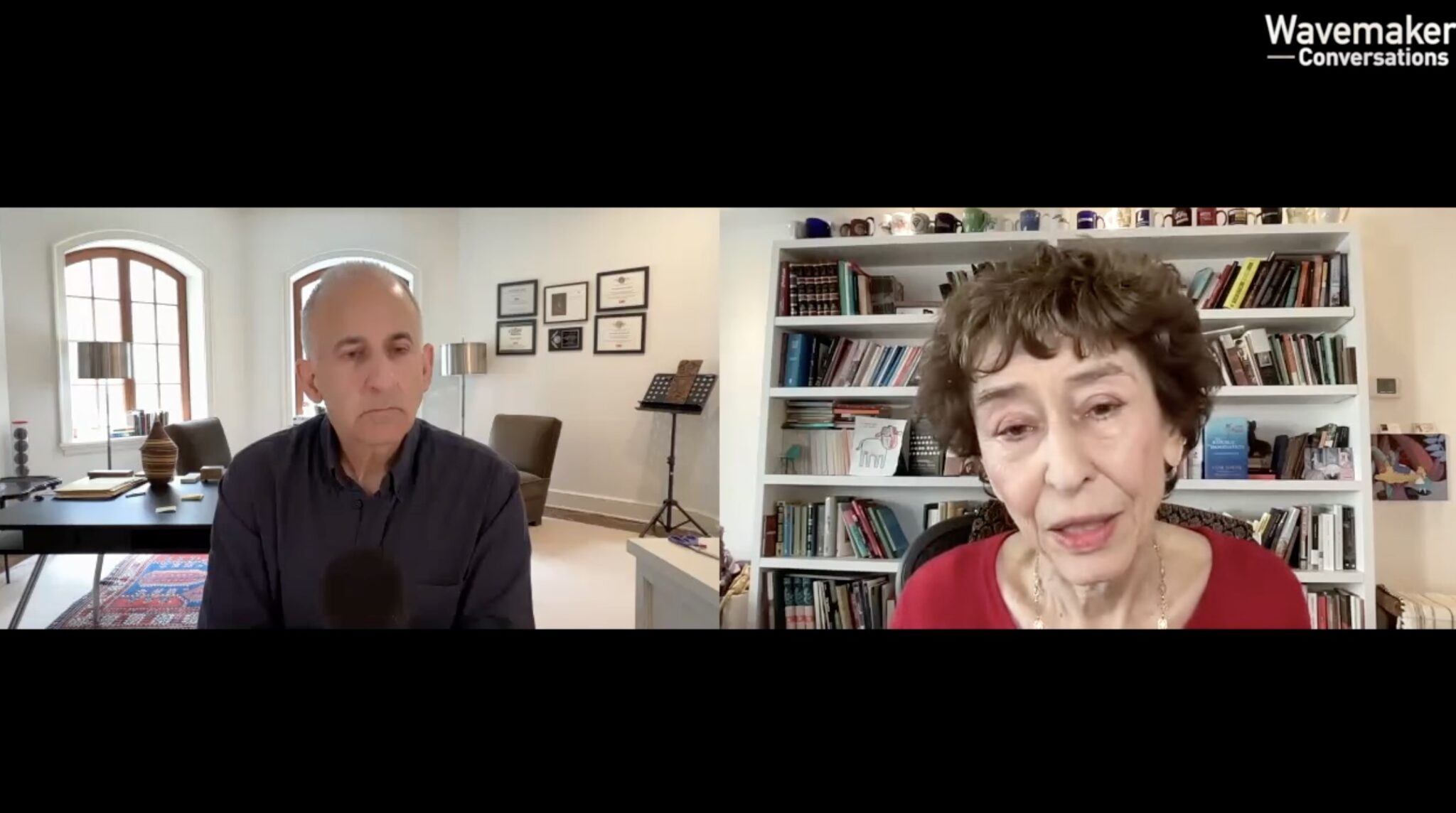
Azar grew up in Tehran. Her father served as the city’s mayor. Her mother was one of the first women to serve in Iran’s parliament. Both modeled independent thought — and action — in dramatic ways, which you’ll hear about in our conversation (at 35:04.)
Azar earned a Ph.D. in American and English literature from the University of Oklahoma and returned to her homeland in 1979, after the Islamic revolution, excited to teach western classics to Iranian college students.
Over the following eighteen years, she experienced, as she described it to me, the regime’s “culture of death.” And a political system of “absolutism.”
And you notice anywhere in the world where there is an absolutist, totalitarian regime, their first job is to fabricate. They fabricate their own role, they confiscate your history and they try to shape you . . . according to their desire and wishes.
When she experienced life under this new system and thought about other similar regimes, she was amazed that:
. . . so many people want to live with absolutism, they want someone else to take the responsibility for them. Because when you are a victim of absolutism, you can blame them constantly and you don’t have any responsibility. It’s a nice place to be.”
For those who refuse to be “shaped” by those in power — the risks can be existential.
Azar has many such examples, including one of her former students, a devout Muslim who fell in love with the work of Henry James because of his novels’ independent women. Her name was Razieh. She was executed in prison. Azar shares with us the story (at 27:45) of how Razieh resisted, in prison, in her own way, until the very end.
Azar Nafisi can address these questions about the source of courage for many Iranians because of her own life experience, her deep knowledge of Persian history and culture, and – as you’ll hear – its people’s traditional worship of the great Persian poets.
Poetry wields power under tyranny?
Listen to Azar Nafisi for the evidence.